

Facing the operational challenges posed by climate change and biodiversity loss, Primax incorporates climate and nature topics into the core strategy of its corporate sustainable development. Since the first publication of the TCFD Report in 2022, the company has continuously enhanced the quality of information disclosure. In 2025, we proactively aligned with IFRS S1 and S2 standards issued by the International Sustainability Standards Board (ISSB) and expanded the integration of the TNFD framework, extending the scope of risk identification from a single climate dimension to include dependencies and impacts on natural ecosystems. Through integration with the Enterprise Risk Assessment framework, the Company has achieved the inclusion of climate and nature-related risks into a unified control process. The financialrelated disclosures for this Year align comprehensively with the consolidated financial statements entity in the annual report, ensuring consistency and decision-usefulness of the disclosed Contents. For the complete disclosure of climate and nature-related financial information, please refer to the "Primax 2025 Climate and Nature-Related Financial Disclosures Report (TNCFD)" published this year or this report's sections 2.1 Sustainability Management and Practice, 3.7 Enterprise Risk Management, and 4.7 Natural Assets and Biodiversity. A summary of selected content is provided below:
Climate-related governance
Primax is committed to constructing a resilient governance system, and in 2024, upon approval by the Board of Directors, the "Risk Management Committee" was renamed the "Sustainability and Risk Management Committee." Additionally, a "Risk Management Officer" position, held by the President, was established to ensure that risk control is deeply integrated with Company strategy. In 2025, the Committee convened three meetings to review and report on climate risks, greenhouse gas inventory, and the execution plans for sustainability goals to the Board of Directors. The IFRS sustainability information presented in this report was reported on May 7, 2026, by the convener of the ESG Office to the Sustainability and Risk Management Committee. On the same day, the Committee Chair, Chairman Pan, Yuan-Chung, reported to the Board of Directors, and the disclosures were approved. In addition, the Board of Directors also strengthens sustainability and climate expertise through Ad Hoc training courses, implementing top-down risk supervision and management responsibilities.
To drive transformative momentum, Primax ties ESG metrics to the remuneration of the senior team, linking the annual performance and variable compensation of Vice President-level and above, as well as key business, R&D, and manufacturing management, to sustainability indicators by 5% to 15%. Simultaneously, the Company has established an institutionalized incentive mechanism through the "Energy Conservation and Waste Reduction Management Control Measures," encouraging all employees to participate in energy conservation proposals and incorporating these efforts into the Performance Review to ensure the effective implementation of sustainability measures.
Risk and Opportunity Assessment and Management
In compliance with the IFRS S2 standards and the TNFD framework, Primax Group conducts in-depth assessments of regulations and initiatives related to global climate change and natural ecosystem issues. The Company identifies potential climate (transition and physical) and natural (dependence and impact) risk factors within its operational sites and value chain. Risk assessment teams analyze impact scenarios specific to different regions in accordance with the "Corporate Risk Management Implementation Rules" and an integrated methodology, evaluating their potential impacts on the company's operations, finances, and ecosystems.
For each topic, the Company calculates expected risk exposure values over the short, medium, and long term through scenario analysis and setting key assumptions, and combines these with risk response measures to perform costbenefit analyses and quantitative assessments of financial impacts. The risk rating of all topics is uniformly identified based on "likelihood × impact level," considering the organization's resilience and adaptability, to establish the key climate and nature-related risks and opportunities. Based on this, dynamic management strategies and transition plans are formulated.
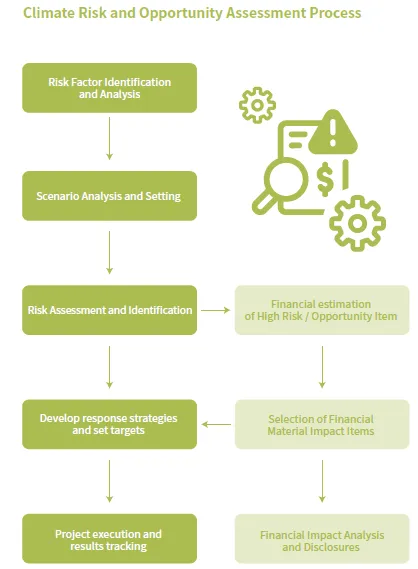
Climate Scenario Analysis
In view of the high uncertainty of risk issues arising from sustainable development and natural environmentrelated topics, Primax in 2025 referred to assumptions proposed by internationally credible research institutions and related assessment tools as the basis for risk reference during the Risk Assessments process. Through these assumptions, scenario analysis was conducted to comprehensively identify potential risks and opportunities, strengthen the grasp of future uncertainties, and incorporate the results of the scenario analysis into overall Risk Assessments for decision-making reference, thereby enhancing the completeness and foresight of Risk Management.
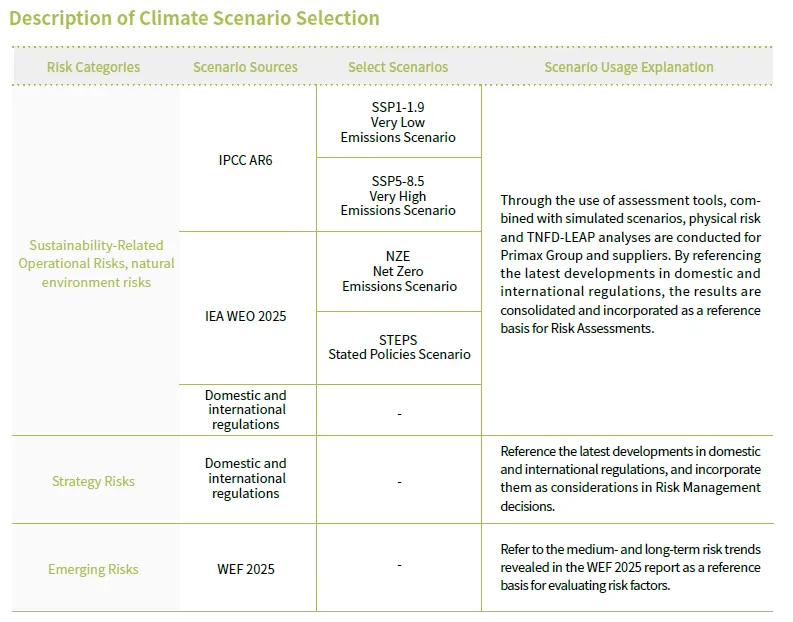
Transition Risk Scenario Analysis
The scope of Primax 2025's transition risk scenario simulation assessment covers all Operational Sites in the Group's consolidated financial statements. The transition risks were developed with the reference to the latest World Energy Outlook report published by the IEA, the main assumptions, and Primax's 2050 net-zero pathway. However, the government policies and regulations direction of the countries where different production and Operational Sites are located will be adjusted on a rolling basis over time and are highly uncertain. Primax will closely monitor regulatory changes in the locations of its various sites. The significant areas of uncertainty in the Transition Risk Scenario Analysis include policy changes, technological advancements, shifts in market demand, environmental changes, and economic factors.
Physical Risk Scenario Analysis
To further understand the impact of physical risks on Primax Group's operations, Primax referred to greenhouse gas emission scenarios presented in the Sixth Assessment Report (AR6) issued by the Intergovernmental Panel on Climate Change (IPCC), as well as national or regional level variables and relevant domestic and international assessment tools, prior to the assessment of natural environment risks. This evaluation covers potential or actual disasters induced by risks such as sea-level rise, water resource stress, drought, high temperatures, floods, and natural resource dependency. The Risk Assessment Teams considered past actual events, scenario analysis simulation results, potential financial impacts, and, based on the simulation assessment timelines of different physical risks, further comprehensively evaluated the impact and likelihood of each risk occurrence.
Key Risks and Opportunities
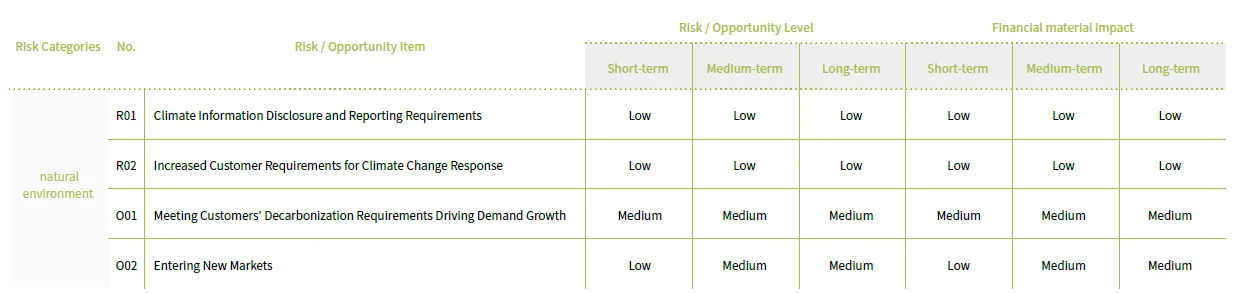
In 2025, after evaluation through the risk matrix, although there were no high risk items concerning natural environment risks this year, Primax proactively incorporated "Customer Climate Change Response Requirements" and "Natural Information Disclosure Requirements" into key monitoring in response to international regulations and customer demand trends. In addition, through the concurrent assessment of risks and opportunities, potential opportunities such as "Meeting Customers' Decarbonization Requirements" and "Entering New Markets" were identified, and their impacts on cash flows and financial performance were further analyzed, implementing IFRS S2 disclosure requirements and strengthening the company's long-term resilience.
Climate-related Financial Impact Assessment
Based on the identified risks /opportunities, Primax etimates the potential financial changes that climate change may bring to Primax. It formulates risk response strategies and conducts cost and benefit assessments for "Cost Management" and "Benefit Management." The financial impact of climate risks/opportunities is assessed and estimated for the short-term (2024 ~ 2025), mid-term (2026 ~ 2028), and long-term (2029 ~ 2033) timeframes.
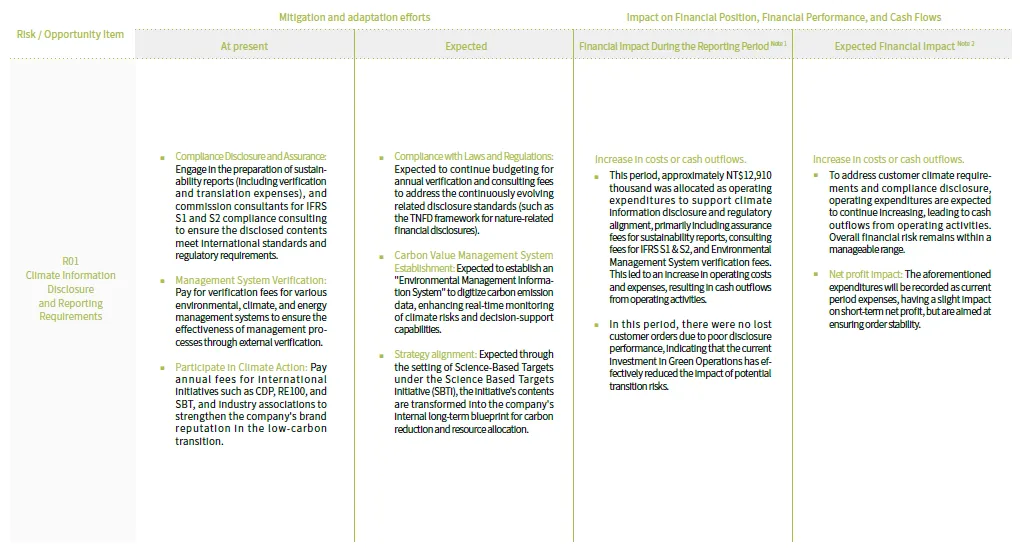
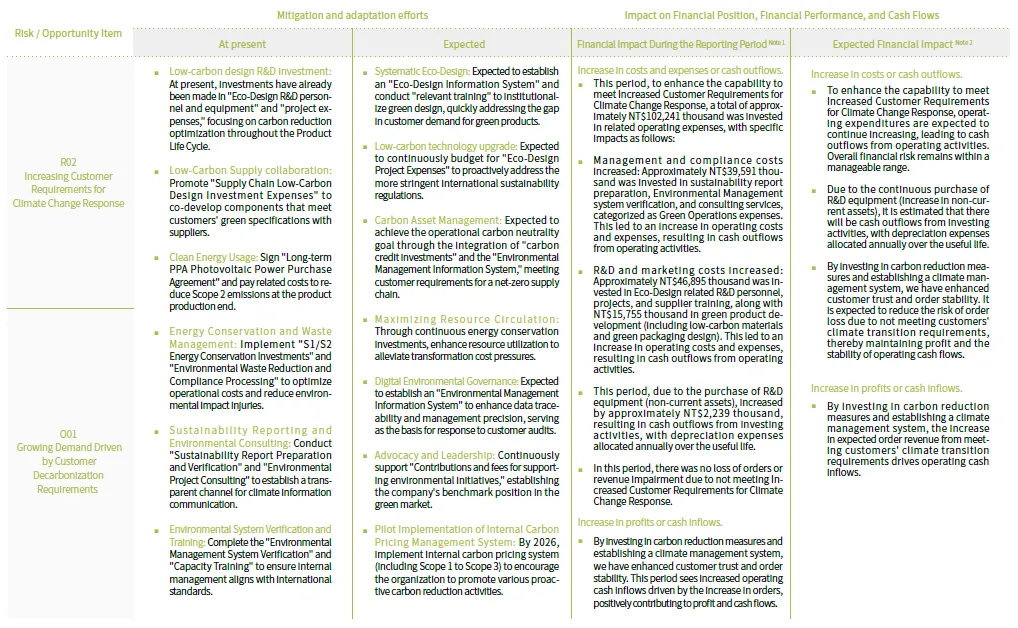
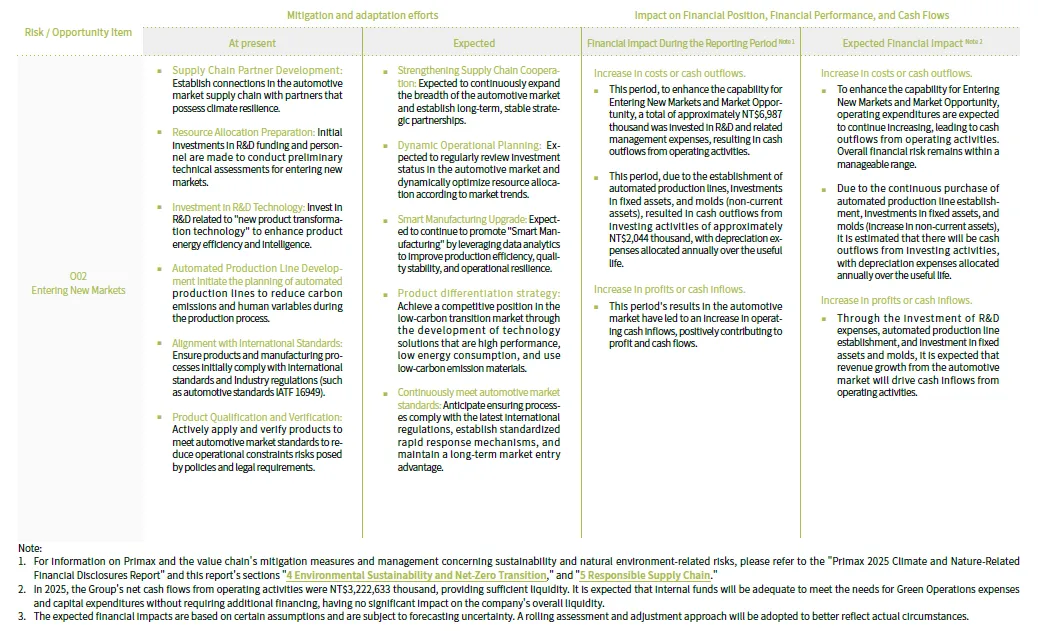
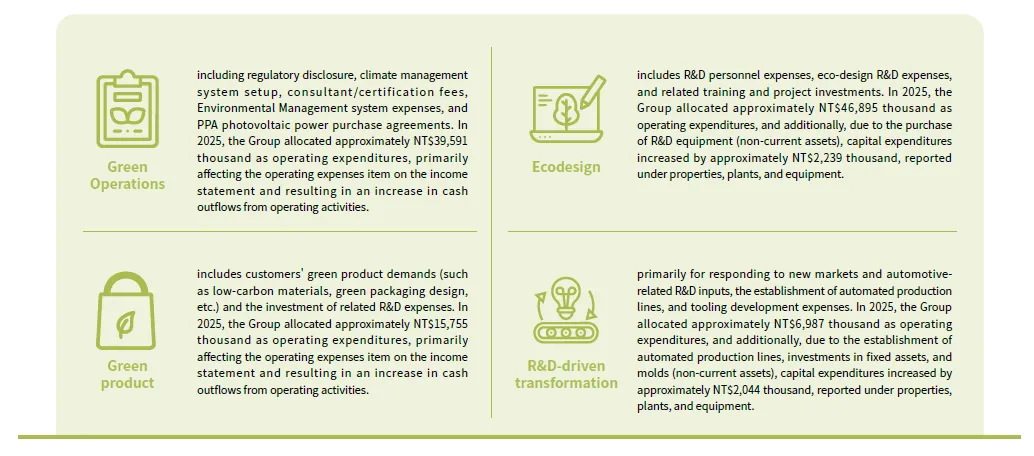
Overall, Primax's management measures for the key risks/opportunities related to the natural environment can be categorized into four main areas: Green Operations, Green Products, Eco-Design, and R&D-Driven Transformation. These initiatives have had no significant impact on Primax Group's cash flows, financial performance, or financial position. Primax Group continues to grow steadily and strengthens its resilience and competitive advantage through forward-looking sustainability strategies and climate change management. As global sustainability trends drive industry transformation, Primax will continue to seize opportunities to not only enhance operational efficiency but also lay a solid foundation for long-term development. In 2025, the Group's total investment in four major management strategies was approximately NT$113,511 thousand, representing about 3.99% of the net profit for the year, and has not yet had a significant impact on core operational performance. Besides affecting the operating expenses in the income statement and future depreciation costs, it also increased the carrying amount of noncurrent assets and caused changes in cash flows from operating and investing activities. The related investments are as follows:
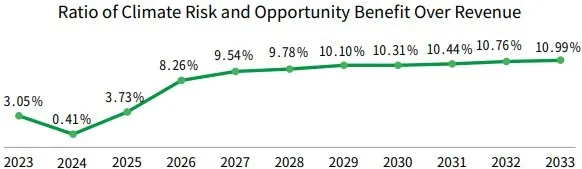
For the identified risk/opportunity items, their corresponding strategies, actions, and expected output benefits are quantified as financial information. The analysis of their impact on revenue composition is presented in the following chart. For the short term (2024 ~ 2025), the average financial impact is estimated to be approximately 2.07% of the operating revenue. For the medium term (2026 ~ 2028), the average financial impact is estimated to be approximately 9.19% of the revenue. For the long term (2029 ~ 2033), the average financial impact is estimated to be approximately 10.52% of the revenue.
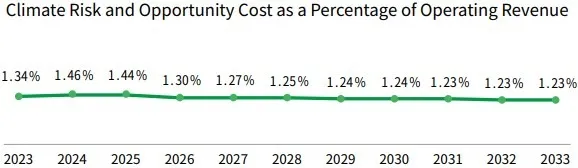
The expected investment cost for all corresponding strategies is summarized according to the risk and opportunity items identified, and such cost includes the addition of facility equipment, increase of R&D cost, cost for recycled materials, and investment in sustainability projects, etc. The financial impact scenario of Primax with respect to the climate change investment cost up to the year of 2033 is estimated. For the short term (2024 ~ 2025), the average financial impact is estimated to be approximately 1.45% of the revenue. For the medium term (2026 ~ 2028), the average financial impact is estimated to be approximately 1.27% of the operating revenue. For the long term (2029 ~ 2033), the average financial impact is estimated to be approximately 1.24% of the operating revenue.
Net Zero Commitment
Primax actively aligns with international initiatives and internationally recognized methodologies. In 2023, the Company adopted the approach defined by the Science Based Targets initiative (SBTi) to establish emissions reduction targets for its major production sites, Primax (Kunshan) and Primax (Chongqing), in line with the 1.5° C pathway. In the same year, these targets were officially approved by the SBTi. Based on the 2024 greenhouse gas inventory results, both sites achieved and exceeded their annual emissions reduction targets. Primax Group submitted its SBT 1.5° C net-zero commitment in January 2024 and submitted its target at the end of 2024. In April 2025, the SBTi approved the Group's 1.5° C net-zero target. Primax will continue to advance mitigation and innovation activities to reduce greenhouse gas emissions and work toward achieving net-zero emissions by 2050.
Please refer to "2024 TCFD Climate-related Financial Disclosures Report" for complete information on Primax's climate change risks. Please refer to the Chapter 4 Environmental Sustainability herein for climate change response management actions and performs.
Please refer to "2024 TCFD Climate-related Financial Disclosures Report" for complete information on Primax's climate change risks. Please refer to the Chapter 4 Environmental Sustainability herein for climate change response management actions and performs.
| Qualified SBTi 1.5℃ short-term goal review Qualified SBTi 1.5℃ short-term goal review in 2023 | |
| Primax Chongqing | Primax Kunshan |
| 1. Reduction of Scope 1 & 2 absolute emissions by 46% in 2030 in comparison to the emissions in the base year of 2020. 2. Reduction of Scope 3 absolute emissions for products and services purchased by 25% in 2030 in comparison to the emissions in the base year of 2021. | 1. Reduction of Scope 1 & 2 absolute emissions by 64% in the target year, 2030, in comparison to the emissions in the base year of 2020. 2. Reduction of Scope 3 absolute emissions for products and services purchased and the use of sales products by 25% in the target year, 2030, in comparison to the emissions in the base year of 2021. |
| 2023 SBT execution results | |
| 1. Scope 1+Scope 2 emits a total of 1619.2126 ton CO2e, which is a decrease of 62.91% compared with the base year of 4365.3312 ton CO2e. (Market Based) 2. Scope 3 (C1) emits a total of 143564.50 ton CO2e, a decrease of 11.10% compared with the base year of 161488.05 ton CO2e. | 1. Scope 1+Scope 2 emits a total of 738.7645 ton CO2e, which is a decrease of 68.09% compared with the base year of 2315.3017 ton CO2e. (Market Based) 2. Scope 3 (C1+C11) emits a total of 6401.94 ton CO2e, a decrease of 72.81% compared with the base year of 23541.29 ton CO2e. |

PS: The above data does not include production from transferred factories
Please refer to "2024 TCFD Climate-related Financial Disclosures Report" for complete information on Primax's climate change risks.Please refer to the Chapter 4 Environmental Sustainability herein for climate change response management actions and performs.