

Wastewater management
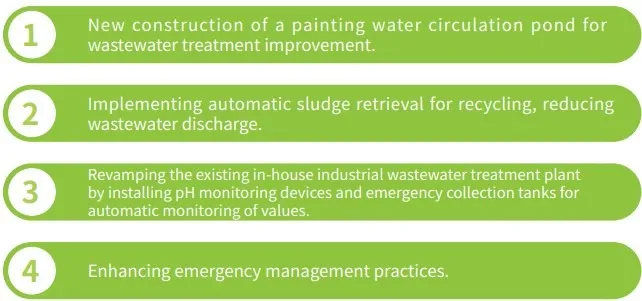
River not only serves as a source of water, but also provides habitat that is vital to creating biodiversity. For this reason, we have devoted part of our environmental focus to keeping rivers clean. By tracking the volume of water discharged, we are able to ensure effective management of production waste water. In addition to the improvements made in 2016 , the Company also implemented a number of environment-friendly measures this year, such as:
Furthermore, our stringent requirements on hazardous substances in raw materials and consumables exceed international regulations. The discharge of wastewater does not contain harmful substances that would adversely affect receiving bodies of water. Except for Primax (Dongguan), all other sites in the Group are primarily assembly plants and do not generate industrial wastewater. Industrial wastewater discharged from Primax (Dongguan) fully complies with Guangdong Province's local emission standards, Water Pollutant Discharge Limits. Other sites discharge only domestic and utility wastewater, which is directed into municipal sewer systems or industrial parks in accordance with regulations and does not have significant impacts on local water bodies.
Air pollution management
Primax Group regularly monitors air pollutant emissions at all sites and is committed to reducing air emissions.
Air emissions data and disclosures are summarized in three key points:
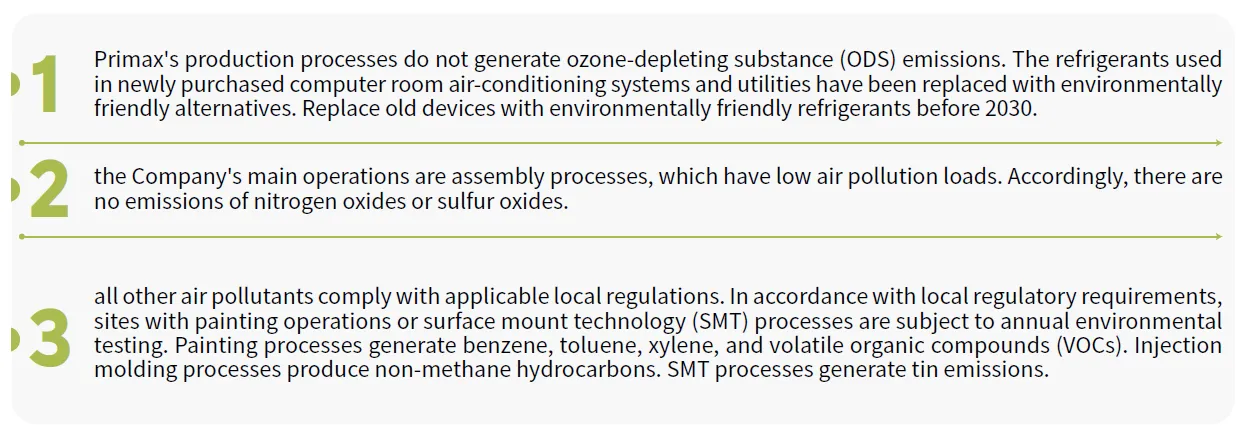
As for air pollution control, the main air pollutants generated at Primax sites include volatile organic compounds such as benzene, toluene, xylene, total VOCs, non-methane hydrocarbons, lead and its compounds, and tin and its compounds. Accordingly, exhaust treatment processes first involve classifying and collecting organic and particulate emissions in sealed systems, followed by installing appropriate air pollution control equipment to ensure compliance with emission standards. To improve exhaust treatment, UV photolysis units were added to the existing wet scrubber and activated carbon adsorption processes. After going through these three stages of treatment, the plants have effectively enhanced exhaust treatment capabilities. In 2025, 100% of all gaseous emissions from Primax Group complied with regulatory standards. To further control VOCs emissions, in addition to ensuring the effectiveness of exhaust treatment equipment, Primax plans to address emissions at the source by developing additional VOCs reduction programs at major sites. For production sites subject to VOCs regulatory requirements, VOCs emissions in 2025 amounted to 1,488 kg.
Note: The statistical data are based on annual periodic monitoring results from each site and are managed through the integrated environmental data management system..
Primax Direct VOCs Emissions
| VOCs (kg) | 2022 | 2023 | 2024 | 2025 |
| Total | 2337.04 | 2776.22 | 1578.56 | 1488.05 |
| The short-term goal is to reduce emissions by 1% per year. | ||||

Waste management
We strive to avoid the premature disposal or landfilling of equipment so that valuable resources can be reused. At the same time, we ensure that these items are recycled appropriately in ways that do not pose risks to employee health or the environment. All hazardous waste is properly stored, managed, and handed over to licensed contractors for compliant treatment. In 2025, Primax Group effectively managed all categories of waste, with no significant waste leakage incidents. All disposal methods fully complied with applicable local regulations.
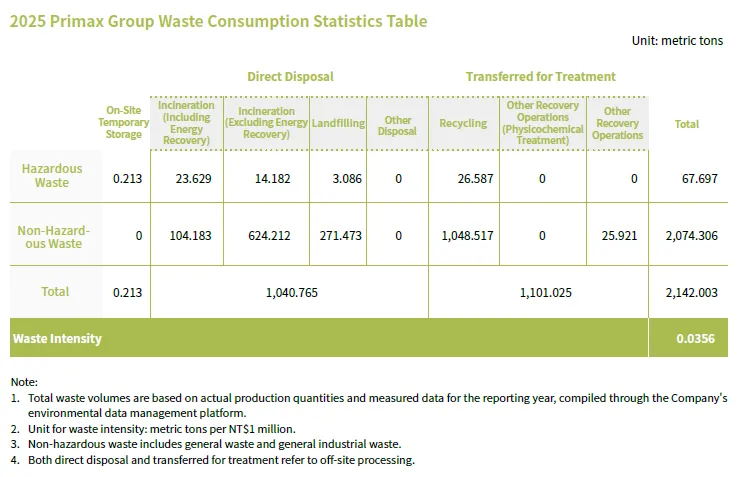
Primax Group's waste is categorized into general waste (including domestic waste) and industrial waste (including hazardous and non-hazardous industrial waste). Industrial waste includes materials such as activated carbon and chemical containers. In 2025, the total waste amounted to 2,142.003 metric tons, decreased by 11.86% compared to the previous year. Waste intensity decreased by 14.70% compared to 2024. By disposal method, 1,040.765 metric tons were directly disposed of (comprising 40.897 metric tons of hazardous waste and 999.869 metric tons of non-hazardous waste). An additional 1,101.025 metric tons were transferred for treatment (comprising 26.587 metric tons of hazardous waste and 1,074.438 metric tons of non-hazardous waste). For details, please refer to the Primax Group Waste Consumption Statistics Table.
We strive to avoid the premature disposal or landfilling of equipment so that valuable resources can be reused. At the same time, we ensure that these items are recycled appropriately in ways that do not pose risks to employee health or the environment. All hazardous waste is properly stored, managed, and handed over to licensed contractors for compliant treatment. In 2025, Primax Group effectively managed all categories of waste, with no significant waste leakage incidents. All disposal methods fully complied with applicable local regulations. In 2025, all major manufacturing sites successfully achieved UL 2799 Zero Waste to Landfill validation.
Environmental protection expenditure
Primax Group leverages its professional expertise to actively pursue process improvements and energy consumption reductions by achieving various assessment targets. These results are supported by our commitment to sustained investment in environmental protection expenditures. Throughthisapproach, we have established ourselves as a model enterprise characterized by high economic benefits, advanced technologies, low resource consumption, minimal environmental pollution, and strong sustainable development capabilities.
Environmental expenditures help assess the effectiveness of environmental measures and provide valuable information for internal cost-benefit analyses. Primax conducts long-term, comprehensive tracking and analysis to ensure that expenditure data supports senior leadership in evaluating the value of complex organizational and technological investments aimed at reducing environmental impacts. At the same time, we continue to develop a comprehensive environmental management accounting system to track information across multiple categories. The focuses include waste treatment, emissions management, remediation costs, and pre vention and environmental management expenses. In 2025, the Group's environmental protection expenditures included pollution prevention, resource conservation, waste treatment, and environment-related management costs, totaling NT$159,898,538.
| Classification of Environmental Cost Items | Explanation | Expenses |
| Direct costs of reducing environmental impact | ||
| (1)Pollution Prevention Costs | Including air pollution control costs, water pollution control costs, and other pollution control costs. | 4,019,768 |
| (2)Resource Conservation Costs | Costs incurred for resource conservation (e.g., water conservation) | 4,667,725 |
| (3)Treatment and Recycling Costs for Industrial and General Office Waste | Costs for industrial waste treatment (including recycling, incineration, landfilling, etc.) | 2,613,251 |
| 2. Indirect Costs of Reducing Environmental Impact (Environment-related Management Expenses) | Including: (1) Employee environmental education and training expenses; (2) Implementation and certification costs for environmental management systems (EMS); (3) Environmental impact monitoring costs; (4) Additional costs for purchasing eco-friendly products; (5) Personnel expenses for dedicated environmental departments. | 148,597,794 |
| Total | 159,898,538 | |